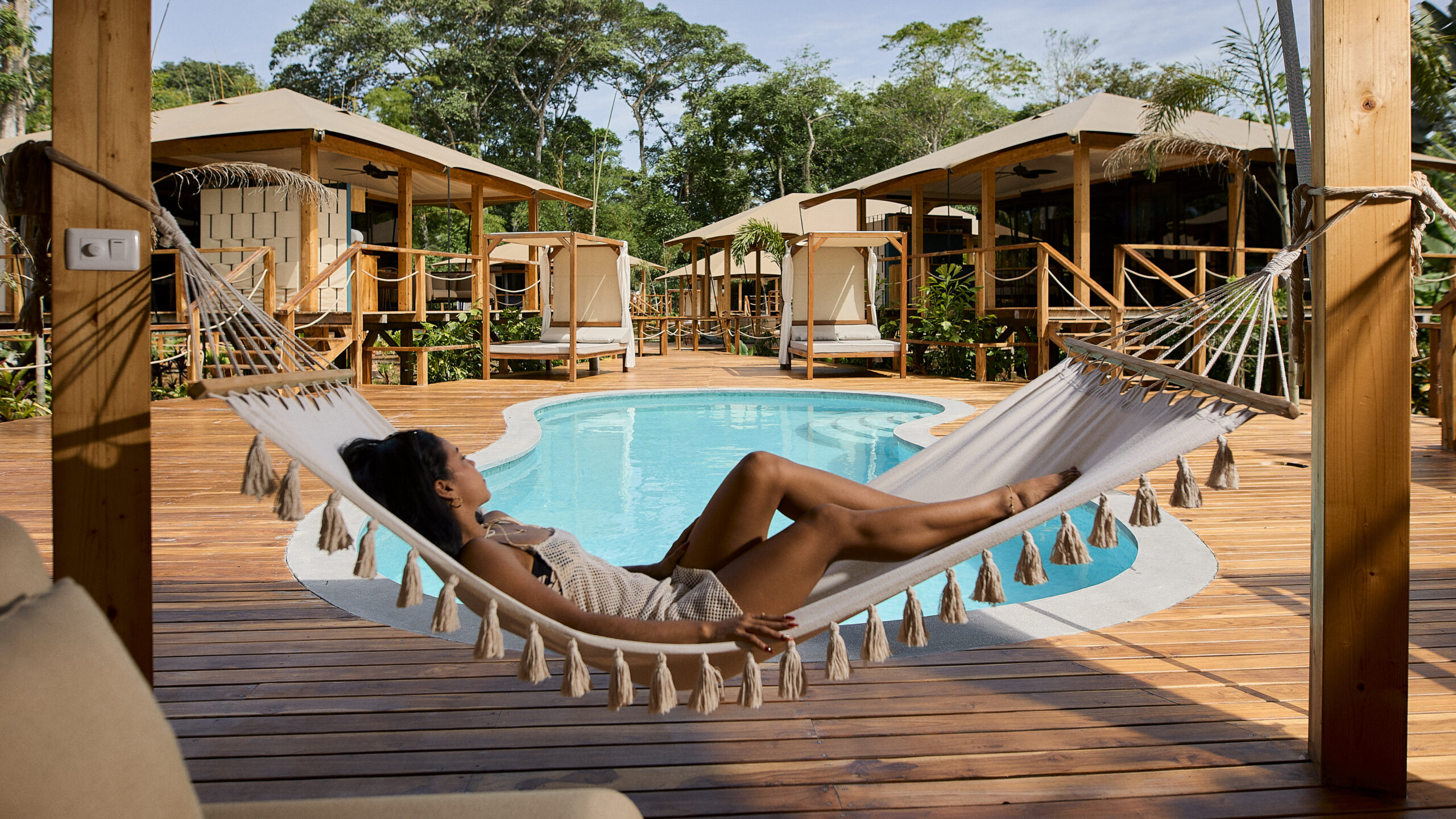
Designed by Nature, Felt by Guests: EVIA Life Resort’s Seamless Harmony
Some resorts arrive on the map fully formed; others feel as though they’ve emerged organically from the landscape. EVIA Life Resort, on Costa Rica’s untamed Caribbean shoreline, belongs to the second category. What began as a life-changing stay in Puerto Viejo evolved into a sanctuary shaped by four friends who believed hospitality could be designed with conscience, emotion and deep respect for place.
“When we first came to Puerto Viejo, we experienced a rare harmony between people and nature,” says Gašper Pavli, CEO of Pura Vida Holding, Ltd. “We didn’t want to copy it. We wanted to honor it.”
The team behind EVIA, which includes Gašper, Jaka, Uroš and architect Robert Klun, describe their journey as equal parts exhilarating and humbling. They built the project from the other side of the world, navigating difficult terrain, permitting challenges and the complexities of working in a remote tropical climate. What kept them going was the conviction that eco-luxury can be both authentic and emotionally restorative.
Gašper puts it simply: “If you’re going to build in a place like this, you can’t arrive with an ego. The environment is your teacher. You listen first, design second.”
Barefoot Luxury Meets Sustainability on the Caribbean Coast
Creating an immersive, gravity-defying experience in Patagonia required both technical expertise and a deep respect for the environment. Every decision was made with sustainability, minimal impact and guest safety in mind.
Marcos Sturzenbaum, owner of Estancia Bonanza, saw the opportunity to blend adventure with luxury in one of the world’s most breathtaking locations. Having encountered similar concepts elsewhere, he wanted to create something unique, designed specifically for Patagonia’s raw beauty and challenging geography. His goal was not just to offer spectacular views, but to create an experience that made guests feel as if they were truly part of the landscape.
The capsules, custom-built for their location, integrate seamlessly with the rock wall. Their design takes into account aerodynamics, wind resistance and geomechanics to ensure stability and safety. Constructing them was a feat of extreme logistics. Because no roads were built, every material had to be transported manually, carried across rivers and small bridges before being lifted up the mountainside by a specially designed gondola system.
The remote location and unpredictable Patagonian weather posed continuous challenges, often limiting the number of workable days and extending the project timeline. Despite these obstacles, the team remained committed to a leave-no-trace philosophy, ensuring that OVO’s presence would be as subtle as possible.
Immersiveness and Sustainability at the Core of the OVO Patagonia Experience
That mindset shaped every stage of EVIA’s creation. Rather than imposing a masterplan, the team allowed the land to dictate the resort’s layout. Each villa sits where the slope, trees, wind and light suggested it should be. Nothing feels forced; the architecture seems to breathe with the jungle. Once construction finished, the team planted more than 900 additional plants to begin a long-term reforestation effort and transform EVIA into a “hidden garden” that grows wilder each year.
The result is what they call “barefoot luxury.” The villas, designed by Robert Klun Architects, blend simple elegance with ecological intelligence. Built on raised platforms and opening to almost 270-degree views, they allow guests to sleep with the windows open, listening to ocean and forest. The structures use passive cooling and natural ventilation to reduce energy demand, which is a philosophy that mirrors the sustainable principles seen in Klun’s high-profile Expo Dubai work.
“It’s luxury that doesn’t have to shout,” Gašper says. “It feels honest. It feels alive.”
Immersive Guest Experiences Shaped by Jungle and Sea
But EVIA isn’t shaped by architecture alone. Its hospitality style is unhurried, intimate and genuine—a tone set by resort manager Hector, whose 30-year career in five-star hotels and on Royal Caribbean Cruise Lines has informed a service culture grounded in presence rather than performance. “As operators, we forget sometimes that people, not buildings, create the real memory,” Gašper adds. “Your team is part of the landscape too.”
For guests, the experience is immersive from dawn to dusk. Days begin with howler monkeys and birdsong and unfold across beaches, cacao farms, jungle trails and wildlife encounters. Whether surfing at Cocles, hiking national parks, visiting Indigenous BriBri communities or floating along calm snorkel bays, guests find themselves surrounded by the same elemental beauty that inspired EVIA’s founders in the first place.
Sustainability at EVIA extends beyond materials. The resort partners with local farmers, artisans and wildlife centres such as the Jaguar Rescue Center, blending ecological responsibility with cultural integration. “Sustainability isn’t a marketing word here,” Gašper explains. “It’s a relationship. You build with the community, not beside it.
Lessons for Glamping Operators: Build with the Land, Not Over It
For glamping operators, EVIA’s journey offers a wealth of insight. The team is clear that their biggest challenges, including logistics, remoteness, supply chains, became catalysts for clarity rather than compromise. “Constraints force creativity,” says Gašper. “The harder the environment, the more intelligently you have to design.”
What surprised them most was how deeply guests connected with the property’s simplicity. Rather than high-tech amenities, visitors raved about the natural ventilation, the sensory immersion, the architectural quietness and the feeling of being held by the landscape. “People are hungry for honesty,” Gašper reflects. “You don’t have to over-build. You have to over-care.”
Looking ahead, EVIA is only the beginning. The team is already designing a second resort in a remote, boat-access-only jungle. It is a project even more ambitious and environmentally embedded than the first. Other countries are under exploration too, with the goal of creating a network of EVIA Life Resorts, each interpreting the same ethos through its own natural and cultural context.
When asked what advice he would give to glamping developers planning their next chapter, Gašper does not hesitate. “Start with meaning, not market. Let your values shape the concept and let the land shape the design. Guests feel it instantly when a place has soul. Eco-luxury isn’t about excess – it’s about empathy, intelligence and harmony.”
EVIA’s story is a reminder that the most successful nature-based resorts are not those that dominate their surroundings, but those that learn from them. And in a world where travellers are seeking deeper connection, not distraction, that philosophy may well define the next era of glamping and eco-hospitality
.